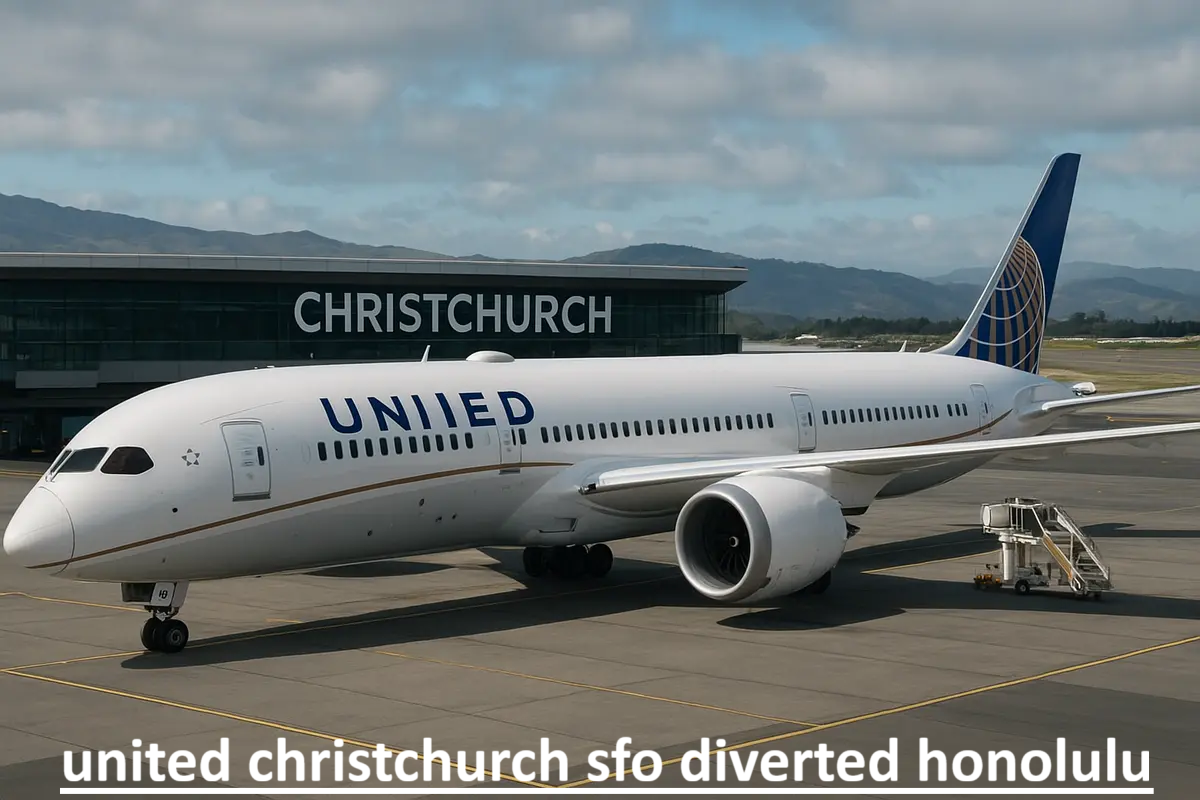
When passengers United Christchurch SFO Diverted Honolulu board a long-haul flight, they anticipate a direct journey to their destination. However, aviation is unpredictable, and sometimes plans change mid-air. On December 10, 2024, passengers aboard United Airlines Flight UA731 from Christchurch, New Zealand, to San Francisco experienced exactly this scenario when their flight was unexpectedly diverted to Honolulu, Hawaii. This incident not only disrupted travel plans but also highlighted the complexities of modern aviation operations United Christchurch SFO Diverted Honolulu and the rigorous safety protocols that airlines must follow.
The Flight That Didn’t Go As Planned
United Airlines Flight UA731 departed Christchurch International Airport at 7:16 PM local time on December 9, 2024, carrying 203 passengers and 13 crew members aboard a Boeing 787-8 Dreamliner (registration N20904). The flight was scheduled for a 13-hour and 10-minute nonstop journey across the Pacific Ocean to San Francisco International Airport. Passengers settled in for the long overnight flight, likely expecting to United Christchurch SFO Diverted Honolulu arrive in California the following day. However, roughly halfway through the journey, the aircraft changed course and began descending toward Daniel K. Inouye International Airport in Honolulu, landing there at 5:11 AM local time on December 10.
The unexpected diversion left passengers with an impromptu layover in Hawaii, and United Airlines confirmed that the original flight’s final leg from Honolulu to San Francisco was canceled. Instead, the airline rebooked all passengers onto another United flight departing later that day, extending what should have been a United Christchurch SFO Diverted Honolulu direct journey into a multi-stop odyssey.
Why Did the Christchurch to SFO Flight Divert to Honolulu?
The reasons behind flight diversions are typically multifaceted, and the United Christchurch SFO diverted Honolulu incident was no exception. According to initial reports, the Boeing 787-8 was experiencing a technical issue with the aircraft that necessitated the diversion. When pilots and airline dispatchers detect potential mechanical or technical problems during flight, safety protocols dictate that the aircraft should land at the nearest suitable United Christchurch SFO Diverted Honolulu airport equipped to handle the situation. Honolulu’s Daniel K. Inouye International Airport, strategically positioned in the middle of the Pacific Ocean, serves as a common diversion point for trans-Pacific flights specifically for these reasons.
However, another significant factor emerged: United Airlines needed to perform a crew change due to legal limits on crew working hours. Aviation regulations imposed by the Federal Aviation Administration (FAA) strictly govern how many hours flight crews can work within a 24-hour period. These regulations exist to prevent pilot and United Christchurch SFO Diverted Honolulu crew fatigue, which can compromise safety. When a flight encounters delays or unexpected circumstances that would push crew members beyond their legal duty limits, airlines must arrange for replacement crews, even if it means diverting the aircraft.
In this case, the combination of a technical issue and crew duty time limitations made Honolulu the logical choice for diversion. The airport has the infrastructure to accommodate wide-body aircraft like the Boeing 787, and United has operational facilities there that could facilitate both aircraft maintenance and crew changes.
The Passenger Experience During an Unexpected Diversion
For the 203 passengers aboard Flight UA731, the announcement of the diversion likely came as a surprise and possibly a source of anxiety. Long-haul international flights represent significant travel investments, both in terms of time and money, and any deviation from the plan can be stressful. Passengers may have had connecting flights, important meetings, or family obligations waiting for them in San Francisco, and the unexpected stop in United Christchurch SFO Diverted Honolulu meant those plans would need to be revised.
After landing in Honolulu at dawn, passengers faced a wait until United could arrange their onward travel. The airline rebooked everyone onto United Flight 3024, which departed Honolulu at 1:45 PM local time that afternoon. This flight successfully reached San Francisco International Airport at 9:07 PM Pacific Time. While the airline worked to minimize the disruption, passengers still experienced a delay of several hours beyond their original United Christchurch SFO Diverted Honolulu scheduled arrival time. During this interim period, passengers likely had questions about compensation, accommodations, and whether their checked luggage would make it to their final destination. United Airlines typically provides meal vouchers and, in some cases, hotel accommodations for extended delays, though the specific arrangements for this flight’s passengers weren’t publicly disclosed.
Understanding Flight Diversions in Modern Aviation
Flight diversions, while inconvenient, are actually a testament to the aviation industry’s commitment to safety. Every year, thousands of flights worldwide are diverted for various reasons, and each diversion represents a United Christchurch SFO Diverted Honolulu decision made by highly trained professionals prioritizing passenger and crew wellbeing over schedule adherence. The reasons for diversions vary widely and include technical malfunctions, medical emergencies, weather conditions, fuel concerns, security threats, and crew duty time limitations.
In the case of technical issues, modern aircraft like the Boeing 787 Dreamliner are equipped with sophisticated monitoring systems that constantly assess the health of critical systems. These systems can detect anomalies United Christchurch SFO Diverted Honolulu that might not be immediately apparent to passengers but could potentially become safety concerns if left unaddressed. When such issues are identified, pilots work in coordination with airline dispatchers and maintenance teams to determine the appropriate course of action. If the issue requires immediate attention, diverting to the nearest suitable airport becomes necessary.
Crew duty time regulations represent another critical safety consideration. Pilot fatigue has been identified as a contributing factor in numerous aviation accidents throughout history, leading regulatory bodies worldwide to implement strict limits on flight and duty times. These regulations consider factors such as the United Christchurch SFO Diverted Honolulu time of day, the number of flight segments, and the total duty period. When circumstances arise that would cause crew members to exceed these limits, airlines must arrange for fresh crews, even if it means diverting the flight or canceling subsequent legs.
Honolulu: The Pacific’s Strategic Diversion Point

The choice to divert United Christchurch SFO Diverted Honolulu wasn’t arbitrary. Hawaii’s geographic position in the middle of the Pacific Ocean makes it an invaluable waypoint for trans-Pacific aviation operations. Daniel K. Inouye International Airport in Honolulu serves as a crucial hub not only for Hawaiian Airlines United Christchurch SFO Diverted Honolulu but also as an emergency and operational diversion point for numerous international carriers operating Pacific routes.
The airport possesses several advantages that make it ideal for handling diverted flights. It features long runways capable of accommodating the largest commercial aircraft, comprehensive maintenance facilities, customs and immigration services for international passengers, and the infrastructure necessary to support stranded travelers. Additionally, United Airlines maintains operational facilities at the airport, which simplifies the logistics of crew changes, aircraft servicing, and passenger rebooking. For flights traveling between United Christchurch SFO Diverted Honolulu North America and Oceania or Asia, Honolulu frequently represents the best option when diversions become necessary. Other potential diversion airports in the Pacific region might lack the same level of facilities or might be too far off-route to be practical.
The Timing: Just Days After Route Resumption
Adding an interesting dimension to this incident, the diversion occurred just four days after United Airlines resumed its direct service between San Francisco and Christchurch, New Zealand. This route represents United’s only direct flight connection between the United States and New Zealand’s South Island, making it an important link for both tourism and business travel. The resumption of the route had been celebrated by United Christchurch SFO Diverted Honolulu aviation officials and tourism representatives in both countries, with Christchurch Airport highlighting the connection’s importance for exports, Antarctic operations support, and U.S. market access.
The timing of the diversion so soon after the route’s restart was unfortunate but not indicative of any systemic problems with the service. Aircraft technical issues can occur on any flight regardless of route maturity, and crew scheduling challenges can arise from various unpredictable factors. Nevertheless, the incident did create an United Christchurch SFO Diverted Honolulu unwelcome headline for what was otherwise meant to be a positive story about renewed international connectivity.
How Airlines Manage Unplanned Operational Challenges
The United Christchurch SFO diverted Honolulu incident provides valuable insight into how modern airlines manage operational disruptions. Behind the scenes, when a flight encounters problems requiring diversion, a complex choreography of communication and coordination takes place. Flight crews work with airline operations centers, which function as the nerve centers of airline operations. These facilities are staffed 24/7 by United Christchurch SFO Diverted Honolulu dispatchers, meteorologists, maintenance coordinators, and crew schedulers who collectively work to resolve issues and minimize passenger impact.
When a diversion is declared, the operations center immediately begins working on multiple fronts. They coordinate with air traffic control to ensure the safest routing to the diversion airport, contact ground services at the destination to prepare for the aircraft’s arrival, arrange for maintenance personnel if technical issues require inspection or repair, and coordinate crew scheduling to ensure replacement crews are available if duty time limits are a concern. Simultaneously, customer service teams begin the process of rebooking affected United Christchurch SFO Diverted Honolulu passengers and arranging for their care during the delay. This entire process must unfold quickly and efficiently, often under considerable time pressure, while maintaining the highest safety standards.
Passenger Rights and Airline Responsibilities
When flights are diverted, passengers naturally wonder about their rights and what compensation or assistance they’re entitled to receive. The specific protections available depend on multiple factors, including the jurisdiction governing the flight, the reason for the diversion, and the airline’s own policies. For international flights like United Christchurch SFO Diverted Honolulu Christchurch to San Francisco service, multiple regulatory frameworks might apply.
Under U.S. Department of Transportation regulations, airlines are required to provide certain amenities to passengers during lengthy tarmac delays, though diversions that allow passengers to deplane at an alternative airport fall under slightly different rules. Generally, airlines are expected to provide meal vouchers for delays of significant length and hotel accommodations for overnight delays caused by circumstances within the airline’s control. However, when diversions result from technical issues or crew scheduling challenges, the United Christchurch SFO Diverted Honolulu situation becomes more nuanced regarding liability and compensation.
United Airlines, like most major carriers, has policies in place for handling diverted passengers. These typically include rebooking passengers on the next available flight at no additional charge, providing meal vouchers, and in some cases offering hotel accommodations and ground transportation. The specific assistance provided often depends on the length of the delay and the circumstances surrounding the diversion.
The Broader Context of Trans-Pacific Aviation Operations
The United Christchurch SFO diverted Honolulu incident is part of a larger narrative about the challenges of operating ultra-long-haul flights across the Pacific Ocean. Trans-Pacific routes are among the most operationally complex in commercial aviation, requiring careful planning regarding fuel loads, weather patterns, alternate airports, crew scheduling, and aircraft performance capabilities. The vast distances involved mean that once a flight is several hours into its journey, options for diversion become limited, making airports like United Christchurch SFO Diverted Honolulu invaluable.
Aircraft range capabilities play a crucial role in Pacific operations. The Boeing 787 Dreamliner, which operated the diverted flight, was specifically designed for long-range efficiency, offering airlines the ability to operate point-to-point routes between cities that previously couldn’t be connected directly. However, even these advanced aircraft have limitations, and factors such as payload weight, weather conditions, and fuel reserves must all be carefully calculated for each flight. When unexpected circumstances arise—whether technical issues, medical emergencies, or crew limitations—the carefully planned flight can quickly require modification.
Learning from Aviation Incidents and Diversions
Every flight diversion, regardless of the cause, provides valuable data and learning opportunities for airlines and aviation safety organizations. Airlines conduct thorough reviews of diverted flights to understand what happened, why it happened, and whether any procedures or processes could be improved to prevent similar occurrences or handle them more effectively in the future. These reviews might examine United Christchurch SFO Diverted Honolulu maintenance procedures, crew training, dispatch practices, and passenger communication strategies.
For the specific case of Flight UA731, United Airlines would have conducted an internal review examining both the technical issue that initiated the diversion and the crew scheduling circumstances that complicated the situation. If the technical problem revealed a maintenance or inspection issue, procedures might be adjusted to catch similar problems earlier. If crew scheduling played a role, the airline might review its duty time management practices for ultra-long-haul routes.
What This Means for Future Christchurch-San Francisco Travelers
Despite the diversion incident, passengers planning to travel on United’s Christchurch to San Francisco route shouldn’t be unduly concerned. Flight diversions, while inconvenient, are actually indicators of proper safety protocols functioning as designed. Airlines don’t divert flights casually—these decisions are made only when necessary to ensure passenger and crew safety. The fact that United followed proper procedures in this case demonstrates the airline’s commitment to safety over schedule adherence.
Travelers on long-haul international routes should always build some flexibility into their travel plans when possible. Allowing extra time for connections, avoiding scheduling crucial meetings immediately upon arrival, and maintaining travel insurance can all help mitigate the impact of unexpected disruptions. Additionally, staying informed about airline policies regarding delays and diversions, keeping the airline’s app downloaded for real-time updates, and maintaining contact information for the airline’s customer service can make managing disruptions significantly easier.
The Human Element in Modern Aviation
While it’s easy to focus on the technical and operational aspects of the United Christchurch SFO diverted Honolulu incident, it’s worth remembering that at the heart of every flight diversion are people—passengers with important destinations and plans, crew members working to ensure everyone’s safety, and ground staff coordinating complex logistics under pressure. The flight crew who made the decision to divert demonstrated professional judgment and adherence to safety protocols. The operations teams who coordinated the passenger rebooking and crew change worked to minimize the impact on travelers. And the passengers, though undoubtedly frustrated and inconvenienced, cooperated with the changed plans.
Modern aviation represents one of humanity’s greatest technological achievements, enabling people to traverse vast distances in relative comfort and remarkable safety. The safety record of commercial aviation has improved dramatically over decades, with fatal accidents becoming increasingly rare. This safety record exists not because things never go wrong, but because the industry has developed robust systems for identifying problems early and responding appropriately when issues arise. The diversion of Flight UA731 represents exactly this system working as intended—identifying a concern and taking appropriate action to ensure safety.
Conclusion: Safety First in Commercial Aviation
The United Christchurch SFO diverted Honolulu incident on December 10, 2024, serves as a reminder that aviation operations, despite decades of technological advancement and operational refinement, remain complex endeavors subject to numerous variables. The decision to divert Flight UA731 to Honolulu, driven by a combination of technical concerns and crew duty time limitations, prioritized safety over convenience—exactly as it should. While the 203 passengers aboard experienced significant delays and disruption to their travel plans, they ultimately reached their destination safely, which remains the paramount concern in aviation.
For the aviation industry, incidents like this provide opportunities to review procedures, refine practices, and continue the ongoing work of making air travel as safe and reliable as possible. For passengers, understanding why diversions occur and how airlines manage them can help reduce anxiety when travel doesn’t go according to plan. And for United Airlines, the incident represents both a challenge successfully managed and an opportunity to demonstrate commitment to safety protocols even when doing so creates operational complications. As air travel continues to connect our world, the lessons learned from each diversion, delay, and disruption contribute to an ever-improving system that safely transports millions of passengers daily across our planet’s skies.