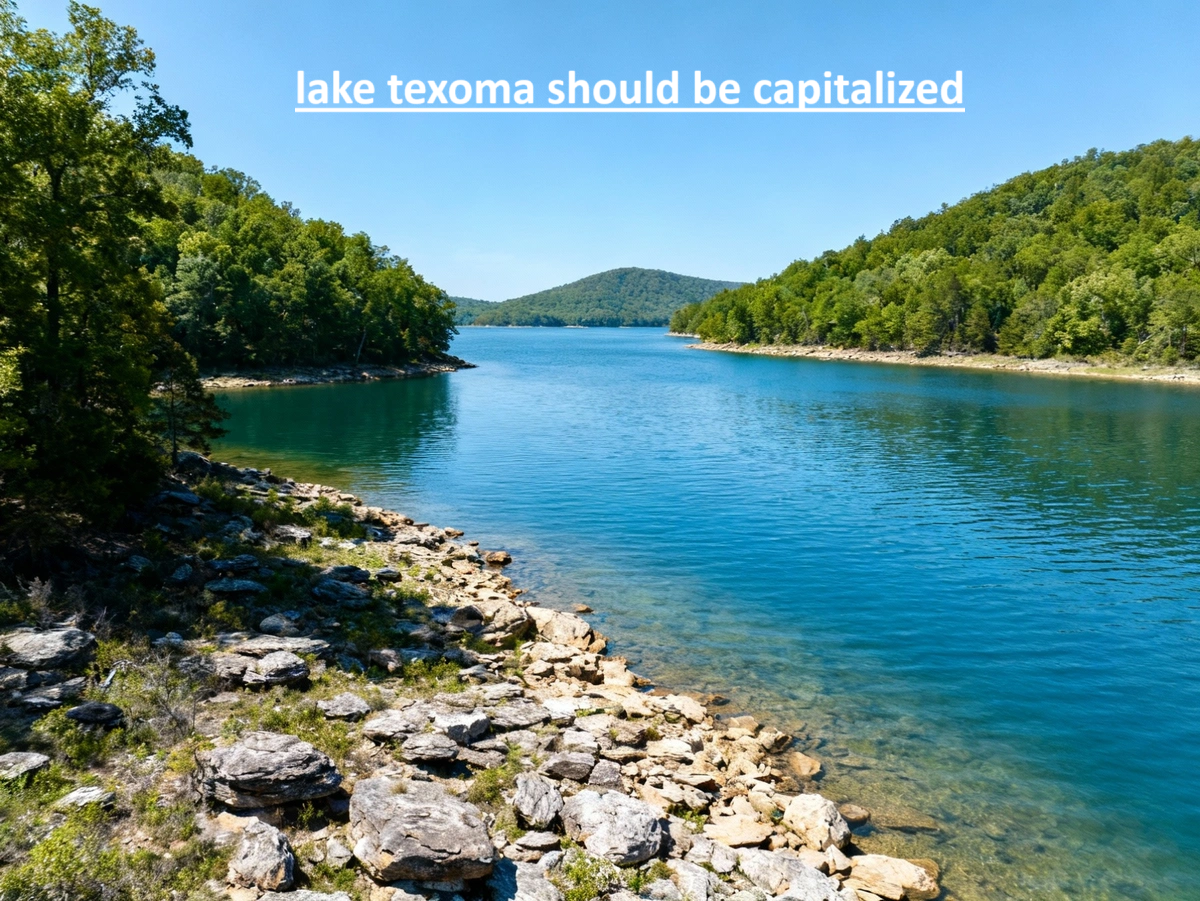
If you’ve ever typed “Lake Texoma Should Be Capitalized” in lowercase and wondered whether you’re doing it wrong, you’re not alone. The question of capitalization might seem trivial, but understanding why Lake Texoma should be capitalized reveals important principles about proper nouns, geographic naming conventions, and respectful communication. Whether you’re writing a travel blog, crafting professional correspondence, or simply Lake Texoma Should Be Capitalized’ want to get your grammar right, this guide will explain everything you need to know about capitalizing Lake Texoma and similar place names.
Understanding the Basic Rule: Lake Texoma Should Be Capitalized
Lake Texoma should be capitalized because it’s a proper noun—specifically, the official name of a geographic location. Just like you wouldn’t write “new york city” or “mount everest” in lowercase, Lake Texoma deserves the same treatment. This reservoir, straddling the Texas-Oklahoma border, has a specific, official designation that distinguishes it from any other body of water. When we capitalize both “Lake” and “Texoma,” we’re acknowledging that this isn’t just any lake; it’s a particular place with its own identity, history, and significance.
The capitalization applies to both words because they form a single proper name. Think of it this way: “Lake Texoma Should Be Capitalized'” becomes part of the proper noun rather than just a generic descriptor. You’re not discussing “a lake called Texoma”—you’re referring to “Lake Texoma,” where the entire phrase functions as one unique identifier.
The Grammar Behind Proper Nouns and Place Names
Proper nouns are names given to specific people, places, or things, and English grammar rules require them to be capitalized. Geographic features with official names fall squarely into this category. Lake Texoma fits the Lake Texoma Should Be Capitalized’ definition perfectly because it’s a designated reservoir created in 1944 by the Denison Dam on the Red River. The United States Army Corps of Engineers officially named it, making “Lake Texoma” its formal title rather than a casual description.
This principle extends beyond lakes to all named geographic features. Mountains like Mount Rushmore, rivers like the Mississippi River, and oceans like the Pacific Ocean all follow the same capitalization rules. The pattern is Lake Texoma Should Be Capitalized’ consistent: when a generic term (lake, mountain, river) combines with a specific name (Texoma, Rushmore, Mississippi), both elements receive capital letters because together they form one proper noun.
Why Lowercase “lake texoma” Is Grammatically Incorrect
Writing “lake texoma” in all lowercase violates standard English capitalization rules and can make your writing appear unprofessional or careless. It’s comparable to writing “i went to paris” instead of “I went to Paris”—technically the reader understands what you mean, but it signals either ignorance of basic grammar rules or a Lake Texoma Should Be Capitalized’ disregard for proper writing conventions. In professional, academic, or published contexts, this mistake stands out immediately to editors and educated readers.
Beyond grammar rules, using lowercase diminishes the specificity and importance of the place itself. Capitalization serves a functional purpose in writing: it helps readers quickly identify proper nouns and understand when you’re referencing something specific versus speaking generally. When you write “we visited lake texoma,” Lake Texoma Should Be Capitalized’ readers must work slightly harder to process that you’re talking about a particular location rather than making a generic statement about a lake.
When Both Words Get Capitals: The Complete Name Rule
The general rule is straightforward: capitalize both “Lake” and “Texoma” when they appear together as the location’s name. This applies in all standard writing contexts—news articles, travel guides, official documents, social media posts, and casual emails. The only exception would be stylistic choices in certain types of creative Lake Texoma Should Be Capitalized’ writing or poetry, where authors sometimes intentionally break capitalization rules for artistic effect. However, in 99% of practical writing situations, Lake Texoma should always appear with both words capitalized.
It’s worth noting that if you’re using “lake” as a generic term before specifying which one, you’d write it differently. For example: “We’re going to a lake—Lake Texoma, specifically.” But whenever you’re directly naming the location, both words receive capitals.
Comparing Lake Texoma to Other Geographic Features
Lake Texoma follows the same capitalization pattern as thousands of other named geographic features across the United States and worldwide. Consider Lake Michigan, Lake Superior, and Lake Tahoe—all capitalize both elements. The same applies to international locations like Lake Geneva in Switzerland or Lake Victoria in Africa. This Lake Texoma Should Be Capitalized’ consistency across English-language naming conventions makes the rule easy to remember and apply.
The pattern holds for other geographic feature types too. Think about how we write Rocky Mountains, Grand Canyon, Chesapeake Bay, and Cape Cod. In each case, both the descriptive term and the specific name receive capital letters. This universal application means that once you understand the principle for Lake Texoma, you can Lake Texoma Should Be Capitalized’ correctly capitalize virtually any named geographic location you encounter.
The Historical Significance of Lake Texoma’s Name

Lake Texoma Should Be Capitalized name itself carries historical meaning that reinforces why it should be capitalized as a proper noun. The name “Texoma” is a portmanteau combining “Texas” and “Oklahoma,” the two states that the lake borders. This creative naming reflects the reservoir’s unique position as a shared resource between two states and acknowledges its role in bringing these neighboring regions together. When the Army Corps of Engineers completed the Denison Dam in 1944, they needed a name that honored both Lake Texoma Should Be Capitalized’ states equally, and Texoma was born.
Understanding this backstory adds weight to the capitalization requirement. Lake Texoma isn’t just a descriptive phrase—it’s a carefully chosen name with cultural and political significance. The capital letters honor that naming decision and the binational character of this important reservoir, which serves millions of people across Lake Texoma Should Be Capitalized both states.
Common Mistakes People Make With Lake Texoma Capitalization
One frequent error is capitalizing only “Texoma” while leaving “lake” in lowercase, as in “lake Texoma.” This mistake probably stems from thinking of “lake” as merely a descriptive word rather than part of the proper name. While “Texoma” is undoubtedly the more distinctive part of the name, “Lake” still requires capitalization when it’s Lake Texoma Should Be Capitalized both part of the official designation. Think of it as similar to “Mount Rushmore”—you wouldn’t write “mount Rushmore” even though “Rushmore” is the unique identifier.
Another common mistake occurs in hashtags and social media handles, where users sometimes write #laketexoma or @laketexoma without capitals. While social media platforms are often more casual, and hashtags technically don’t support spaces, it’s still good practice to use camel case for readability: #LakeTexoma. This Lake Texoma Should Be Capitalized both maintains the proper noun recognition while adapting to platform constraints.
How to Remember the Capitalization Rule
The easiest way to remember that Lake Texoma should be capitalized is to ask yourself one simple question: “Is this a specific place with its own name?” If the answer is yes, capitalize it. You can also use the substitution test—try replacing the name with another well-known place. If you would capitalize the substitute, you should capitalize the original. For instance, you wouldn’t write “We’re going to new york,” so you shouldn’t write “We’re going to lake texoma.”
Another memory trick is to think of the lake as a person. You’d capitalize someone’s full name, like “Sarah Johnson,” right? Apply the same respect to “Lake Texoma.” Both words work together to form the complete name, just like a first and last name, and both deserve capital letters.
Capitalization in Different Writing Contexts
In formal writing contexts—academic papers, business documents, journalism, and official communications—capitalizing Lake Texoma correctly is essential for credibility. Editors and professors will mark lowercase versions as errors, and in professional settings, such mistakes can undermine your authority or attention to detail. If you’re writing a research paper about Oklahoma tourism or a business proposal for lakeside development, proper capitalization demonstrates professionalism.
In casual contexts like text messages, personal emails, or quick notes, people are generally more forgiving of capitalization errors. However, developing the habit of correct capitalization in all contexts ensures you won’t make mistakes when it matters most. Plus, modern smartphones and computers typically auto-correct proper nouns anyway, so there’s little reason not to get it right even in informal communication.
Teaching Children and English Learners About Proper Noun Capitalization
For educators teaching proper noun capitalization, Lake Texoma provides an excellent example because it clearly demonstrates how geographic features work as proper nouns. Children can understand the concept by comparing it to their own names—just as “Emily” gets a capital letter because it’s a specific person, “Lake Texoma” gets capital letters because it’s a specific place. This parallel helps young learners grasp the abstract concept of proper nouns through concrete examples.
English language learners sometimes struggle with capitalization because many languages handle proper nouns differently. In German, all nouns are capitalized, while in languages like French or Spanish, only the first word of a place name typically receives a capital letter. English’s rule—capitalize all significant words in a proper name—sits somewhere in the middle, and Lake Texoma serves as a clear example of how this principle works in practice.
The Role of Style Guides and Official Sources
Major style guides including the Associated Press Stylebook, the Chicago Manual of Style, and the Modern Language Association handbook all agree on proper noun capitalization for geographic features. These authoritative sources confirm that Lake Texoma should be capitalized in all standard usage. When you check official sources like the U.S. Geological Survey’s Geographic Names Information System, you’ll find “Lake Texoma” listed with both words capitalized, further confirming the correct format.
If you’re ever uncertain about how to capitalize a place name, consulting official government sources or reputable style guides will provide the answer. The United States Board on Geographic Names serves as the federal authority for geographic nomenclature, and their records consistently show proper capitalization for named features like Lake Texoma.
Why Correct Capitalization Matters for SEO and Online Content
In the digital age, correct capitalization also affects how your content performs online. Search engines have become sophisticated enough to understand that “Lake Texoma,” “lake texoma,” and “LAKE TEXOMA” refer to the same place, but proper capitalization in your content signals quality and authority. Well-written content that follows standard grammar rules tends to perform better in search rankings because it indicates expertise and trustworthiness.
For businesses operating near Lake Texoma—marinas, resorts, fishing guides, or real estate agencies—using correct capitalization in website content, business listings, and marketing materials reinforces professionalism. Customers searching for “Lake Texoma resorts” expect to see the name properly capitalized in search results and on business websites, and deviations from this norm can create subtle doubts about legitimacy or attention to detail.
Regional Variations and Local Usage
Interestingly, locals who visit Lake Texoma frequently might sometimes use casual lowercase in very informal settings, much like New Yorkers might text “meet me in the city” rather than “meet me in New York City.” However, this casual shorthand doesn’t change the grammatical rules—it’s simply a matter of context and audience. In any setting where clarity and correctness matter, Lake Texoma should always be capitalized.
Regional publications, tourism boards, and local government websites consistently use proper capitalization for Lake Texoma, setting the standard for both residents and visitors. The Lake Texoma Association, local chambers of commerce, and state tourism departments all capitalize the name correctly in their official materials, providing models for proper usage.
Final Thoughts on Respecting Place Names Through Proper Capitalization
Ultimately, capitalizing Lake Texoma correctly is about more than just following grammar rules—it’s about showing respect for places and the people connected to them. Every named location has a story, and proper capitalization acknowledges that significance. Lake Texoma represents a major engineering achievement, an important natural resource, a recreational destination for millions, and a defining geographic feature for communities on both sides of the Texas-Oklahoma border.
When you take the extra moment to capitalize Lake Texoma properly, you’re participating in a broader linguistic tradition of honoring specific places with specific names. It’s a small detail that carries meaningful weight, ensuring clear communication while demonstrating your commitment to accurate, professional writing. Whether you’re a student, a professional writer, a business owner, or simply someone who wants to communicate correctly, remembering that Lake Texoma should be capitalized will serve you well in all your writing endeavors.