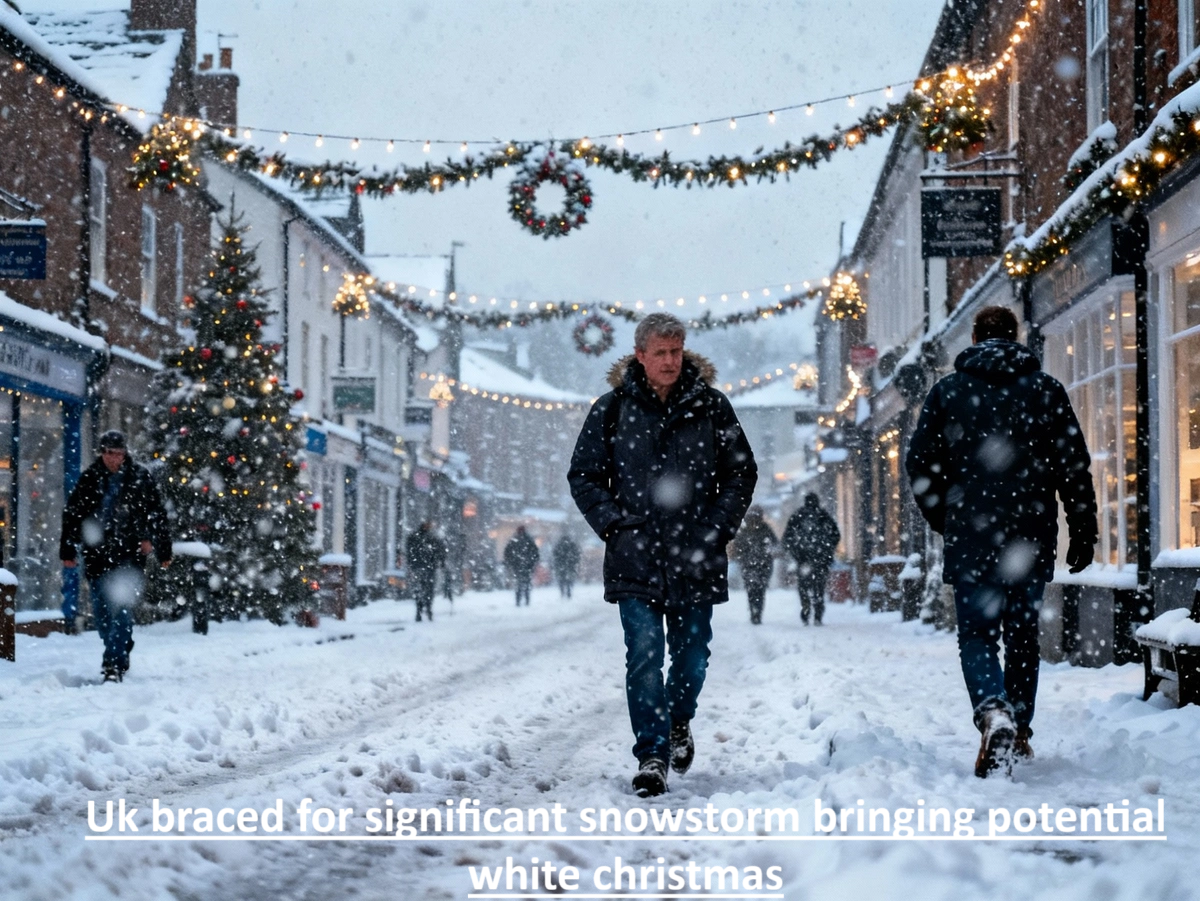
As the UK Braced for Significant Snowstorm Bringing Potential White Christmas transitions into the heart of winter, meteorologists are keeping a close eye on developing weather patterns that could deliver something millions dream about every year—a genuine white Christmas. With November 2025 already showing signs of transitional weather and forecasters predicting a more eventful winter season ahead, residents across Britain are preparing for what could be one of the most memorable festive periods in recent years. From snowfall forecasts to regional variations, here’s everything you need to know about the UK’s winter weather UK Braced for Significant Snowstorm Bringing Potential White Christmas outlook and the realistic chances of waking up to a winter wonderland on December 25th.
The Current Weather Pattern Setting the Stage
November 2025 has painted a picture of classic British autumn weather transitioning into winter. The first half of November experienced typical changeable conditions with rain and mild southerly winds keeping temperatures above UK Braced for Significant Snowstorm Bringing Potential White Christmas average, but that’s beginning to shift. A general downward trend in temperature is expected through this period, reaching below average in many areas beyond mid-November, with showers potentially wintry over high ground and occasionally at low levels in the far north.
What’s particularly interesting about the current pattern is the increasingly likely arrival of high-pressure systems toward late November. These spells of high pressure could bring more dry weather compared to recent patterns, while also increasing the chances of overnight fog and frost. This setup is creating the perfect foundation for UK Braced for Significant Snowstorm Bringing Potential White Christmas what forecasters are calling a potentially significant winter ahead.
Understanding the Science Behind Winter 2024/2025 Predictions
The winter of 2024/2025 isn’t just another typical British winter—several atmospheric conditions are aligning to create circumstances that favor colder, snowier weather. 2025 is a La Niña year, characterized by cooler than average temperatures in the central and eastern Pacific Ocean near the equator, which can increase the likelihood of a colder and drier start to winter in the UK. This phenomenon works by influencing the jet stream, UK Braced for Significant Snowstorm Bringing Potential White Christmas that crucial band of fast-moving winds that determines where precipitation falls across Europe.
The stratospheric polar vortex also plays a crucial role in determining winter severity. When these high-altitude winds are weakened or reversed through an event called a sudden stratospheric warming, the likelihood of cold snaps across mid-latitude countries where the UK is located significantly increases. Combined with La Niña conditions, these factors are painting a picture of a winter that could deliver more frequent cold spells and UK Braced for Significant Snowstorm Bringing Potential White Christmas increased snowfall compared to recent mild winters.
What Actually Happened: A Reality Check on Recent Winter Weather
Before getting too excited about predictions, it’s worth examining what the UK actually experienced in the most recent winter season. Winter 2024/25 saw below average rainfall, below average sunshine, and above average temperatures for the UK, with a mean temperature of 4.6°C, just over half a degree above the long-term average. UK Braced for Significant Snowstorm Bringing Potential White Christmas However, these statistics mask some dramatic weather events.
Storm Darragh in December and Storm Éowyn in January both warranted Met Office Red National Severe Weather Warnings for their significant risk to life, with Storm Éowyn bringing winds gusting widely at well over 80mph and recording the UK’s most powerful windstorm in over a decade. The reality is that UK winters increasingly feature UK Braced for Significant Snowstorm Bringing Potential White Christmas this mix—overall milder conditions punctuated by intense, short-lived extreme weather events.
Regional Snow Expectations and Timing
When it comes to snowfall distribution across the UK, geography matters immensely. Scotland consistently stands as the region most likely to see significant snow accumulation. The Highlands could see lows of -15°C with extended snow cover throughout January and February, while cities like Glasgow and Edinburgh will generally remain between -6°C and -8°C. Northern England and Wales also face reasonable prospects for UK Braced for Significant Snowstorm Bringing Potential White Christmas wintry weather, particularly in upland areas.
Snow warnings have been issued for parts of Scotland and Northern England, with forecasts suggesting 5-10 cm of snow on ground over 200 meters and possibly 15-20 cm over 300 meters, with potential 5-10 cm at lower levels that could be more disruptive. These warnings highlight how quickly conditions can change and why UK Braced for Significant Snowstorm Bringing Potential White Christmas preparation remains essential, particularly for those living in traditionally snow-prone regions.
The White Christmas Question: Separating Myth from Reality

Perhaps no weather topic UK Braced for Significant Snowstorm Bringing Potential White Christmas captures public imagination quite like the prospect of a white Christmas. But what exactly constitutes a white Christmas, and what are the realistic odds? For the Met Office to declare a white Christmas, a single snowflake has to be observed falling on the 24 hours of December 25 by either an official Met Office observer or automated weather station. This definition is surprisingly lenient—you don’t need snow on the ground, just one snowflake falling somewhere in the UK.
Since 1960, around half of the years have seen at least 5% of the station network record snow falling on Christmas Day, meaning we can probably expect more than half of all Christmas Days to be a white Christmas. However, the Dickensian scene of widespread snow lying on the ground is considerably rarer. The last widespread white UK Braced for Significant Snowstorm Bringing Potential White Christmas occurred in 2010, and while some regions saw light snowfall in 2023, it didn’t settle.
Betting Odds and Regional Probabilities
For those who like to gauge likelihood through betting markets, the odds tell an interesting story about regional variations. According to bookmaker odds, Aberdeen has a strong chance of seeing snow on Christmas Day 2024 with odds of 11/10, translating to approximately a 48% chance, with other Scottish cities like Glasgow and UK Braced for Significant Snowstorm Bringing Potential White Christmas Edinburgh following at 6/1. These odds reflect both historical patterns and current forecast models.
Southern regions face considerably longer odds, with London’s chances of Christmas Day snow significantly lower. London hasn’t seen snow on Christmas Day since 1999, with odds pushed out to 20/1, representing just a 4.8% chance. The message is clear: if you’re dreaming of a white Christmas, your best bet is heading north to UK Braced for Significant Snowstorm Bringing Potential White Christmas Scotland or perhaps the higher elevations of northern England.
Winter Storm Patterns and Travel Disruptions
Beyond Christmas Day specifically, the broader winter season promises significant weather events that could impact daily life and travel. The New Year transition period saw yellow weather warnings for wind, rain, and snow across various parts of the UK, with snow accumulations of 10-20cm over higher ground in Scotland and strong winds creating blizzard-like conditions. These patterns demonstrate how quickly weather can deteriorate UK Braced for Significant Snowstorm Bringing Potential White Christmas during winter months.
Wind gusts of up to 65-75 mph were forecast for exposed locations across England and Wales during early January weather events, highlighting that winter hazards extend beyond just snow. Strong winds combined with rain or UK Braced for Significant Snowstorm Bringing Potential White Christmas create particularly challenging conditions for travel, potentially disrupting both road and rail networks.
What November Typically Brings to the UK
Understanding November’s typical weather patterns helps set realistic expectations for the winter ahead. November marks the final step into winter for the UK, with daytime temperatures typically ranging between 7°C and 12°C, but chilly mornings and cold nights becoming common, particularly under clear skies. Rural and inland UK Braced for Significant Snowstorm Bringing Potential White Christmas areas often dip close to freezing overnight, while urban heat islands keep cities slightly warmer.
November is one of the wettest months of the year, with frequent Atlantic low-pressure systems bringing spells of rain and strong winds, with the west of the UK tending to see the heaviest and most persistent rainfall. This wet, unsettled pattern sets the stage for more wintry conditions as temperatures continue their seasonal decline into December.
Long-Range Winter Outlook Through February
Looking beyond the immediate forecast, meteorologists have identified several key trends for winter 2024/2025. Current long-range forecasts suggest a colder than average season particularly compared to relatively mild recent winters, with forecasts pointing to a mild start in December followed by a significant shift to lower temperatures in January and February. This pattern would deliver the coldest conditions during the heart of UK Braced for Significant Snowstorm Bringing Potential White Christmas winter rather than early in the season.
The likelihood of multiple snow events increases substantially from January onward. Forecasting models suggest January and February could see multiple snow events as colder air from the north and east pushes across the UK, with even southern England potentially seeing temporary accumulations if a sustained easterly airflow develops. This represents a marked departure from the predominantly mild, wet winters experienced in UK Braced for Significant Snowstorm Bringing Potential White Christmas recent years.
Climate Context: The Bigger Picture
While short-term forecasts provide tactical planning information, understanding the broader climate context helps explain why UK winters have become increasingly unpredictable. Despite global warming trends, individual winters can still deliver significant cold spells and snow. However, in a warming world, cold outbreaks may be severely diluted, and despite signals pointing towards colder conditions, the exact impacts to the UK Braced for Significant Snowstorm Bringing Potential White Christmas remain uncertain.
This uncertainty reflects the complex interplay of multiple atmospheric phenomena—La Niña, the polar vortex, the jet stream position, and ocean temperature patterns all contribute to the final weather outcome. No single factor determines whether the UK experiences a mild, wet winter or a cold, snowy one, making long-range forecasting inherently challenging.
Practical Preparation Tips for Winter Weather
Given the potential for disruptive winter weather, practical preparation becomes essential. For those living in areas prone to snow and ice, ensuring vehicles are winter-ready with proper tires, antifreeze, and emergency kits UK Braced for Significant Snowstorm Bringing Potential White Christmas makes good sense. Home preparation should include checking heating systems, insulating exposed pipes, and stocking up on essential supplies before severe weather arrives.
Travel disruption can occur with little warning during winter storms. Monitoring Met Office warnings through their website, app, or social media channels ensures you receive timely alerts about developing conditions. Having flexible travel plans and avoiding unnecessary journeys during severe weather warnings helps reduce UK Braced for Significant Snowstorm Bringing Potential White Christmas personal risk and pressure on emergency services.
The Role of Modern Forecasting Technology
Modern weather forecasting has transformed our ability to predict winter weather events. The Met Office can accurately forecast if snow is likely on any given Christmas Day up to five days beforehand, providing reasonably reliable short-term guidance. However, forecasting snow weeks or months in advance remains extremely challenging due to the chaotic nature of atmospheric systems.
Computer models run hundreds of times to create ensemble forecasts that show likely weather patterns rather than single predictions. This probabilistic approach acknowledges inherent uncertainty while identifying common themes—whether a period is likely to be colder or warmer, wetter or drier than average, even if exact UK Braced for Significant Snowstorm Bringing Potential White Christmas timing and amounts remain uncertain.
Historical Context: Memorable UK White Christmases
History provides perspective on just how rare truly significant Christmas snow events actually are. The last widespread white Christmas occurred in 2010, which also holds the record for the coldest-ever Christmas Day in the UK with around 25cm of snow falling in parts of London. The deepest snow ever recorded on Christmas Day was in 1981, with 47cm measured in Kindrogan, Perthshire.
These historical benchmarks remind us that while snow does fall on Christmas Day reasonably often somewhere in the UK, the picturesque scene of deep, settled snow blanketing the entire country remains exceptional. Managing UK Braced for Significant Snowstorm Bringing Potential White Christmas expectations while remaining prepared for whatever weather arrives represents the most sensible approach.
December Weather Patterns and Christmas Forecast
As we approach the Christmas period specifically, weather patterns typically begin crystallizing in the weeks beforehand. December is expected to see a relatively unsettled start with rain and occasional frosts, with the coldest and snowiest conditions more likely in January and February rather than immediately at Christmas.
The position of high and low-pressure systems during late December will ultimately determine Christmas weather. A high-pressure system over the UK would bring cold, dry conditions with frost and fog but limited snow, while low pressure would deliver milder, wetter weather with snow only on high ground. The outcome remains genuinely uncertain until closer to the date.
Looking Ahead: A Winter Worth Preparing For
While definitive predictions remain elusive, the evidence suggests winter 2024/2025 has significant potential for delivering memorable weather events. The combination of La Niña conditions, potential polar vortex weakening, and seasonal temperature declines creates circumstances favorable for cold spells and snow events, particularly from January onward.
Whether Christmas Day 2024 delivers that picture-perfect white Christmas remains to be seen, with Scotland and northern regions holding the best prospects. Regardless of what Christmas Day specifically brings, the broader winter season looks set to provide plenty of wintry weather to satisfy those longing for cold conditions and snow after several mild winters. Staying informed, remaining flexible, and preparing sensibly ensures you’ll be ready for whatever this winter throws at the UK—whether that’s a white Christmas or simply a typically changeable British winter.
You may also read
United Christchurch SFO Diverted Honolulu