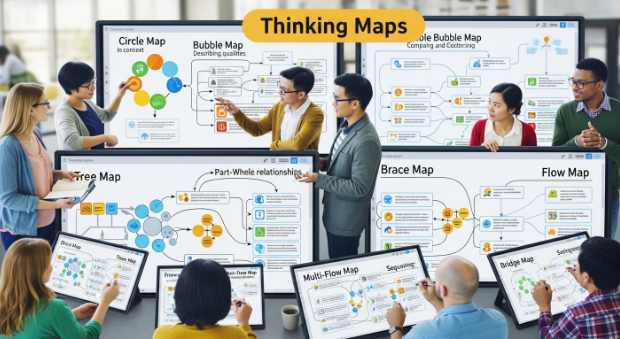
Thinking Maps are powerful visual tools that help students and professionals organize, process, and understand information effectively. These maps simplify complex ideas and enhance critical thinking. Using Thinking Maps encourages creativity, clarity, and improved problem-solving skills. They serve as a bridge between abstract concepts and concrete understanding, making learning more efficient and engaging.
What Are Thinking Maps?
Thinking Maps are graphic organizers that visually represent thought processes. Each map corresponds to a specific cognitive skill such as comparing, sequencing, or analyzing causes and effects. By connecting ideas visually, users can see relationships clearly. These maps help learners structure information logically, which boosts comprehension and memory retention. They are widely used in education, business, and personal development for better decision-making.
Benefits of Using Thinking Maps
Thinking Maps improve learning outcomes by making abstract concepts tangible. They encourage active thinking and allow users to explore multiple perspectives. Students benefit from visual reinforcement, while professionals can simplify complex data. Thinking Maps also foster collaboration, as teams can brainstorm ideas effectively. Over time, these tools enhance problem-solving abilities, organization, and critical thinking skills, promoting lifelong learning.
Types of Thinking Maps
There are eight primary Thinking Maps, each designed for a specific purpose:
- Circle Map – Brainstorming and defining concepts.
- Bubble Map – Describing qualities and attributes.
- Double Bubble Map – Comparing and contrasting ideas.
- Tree Map – Classifying and categorizing information.
- Flow Map – Sequencing events or steps.
- Multi-Flow Map – Analyzing cause and effect.
- Brace Map – Part-to-whole relationships.
- Bridge Map – Understanding analogies and relationships.
Using the correct map ensures clarity and efficiency in learning or problem-solving.
How Thinking Maps Enhance Learning
Thinking Maps enhance learning by supporting visual and logical thinking. They allow students to organize complex information, making it easier to recall. By using these maps, learners actively engage with material instead of passively memorizing it. Teachers find them effective for reinforcing concepts, while learners develop deeper understanding through analysis and reflection. Repeated use strengthens cognitive skills and enhances overall academic performance.
Practical Applications of Thinking Maps
Thinking Maps are versatile and can be used in classrooms, workplaces, and personal projects. In education, they aid reading comprehension, essay writing, and science experiments. Businesses use them for planning, brainstorming, and problem-solving. Individuals can map out personal goals or decision-making strategies. This adaptability makes Thinking Maps an invaluable tool for anyone looking to improve clarity, productivity, and creativity in daily tasks.
Tips for Effective Use of Thinking Maps
To maximize the benefits of Thinking Maps, it is crucial to follow practical strategies. Choose the right map for the task, maintain clarity, and use concise labels. Encourage collaboration to enhance brainstorming sessions. Regular practice improves speed and accuracy in creating maps. Integrating colors, symbols, and images can make maps more engaging and memorable. Finally, revisiting and updating maps ensures they remain relevant and useful.
Common Mistakes to Avoid with Thinking Maps
While Thinking Maps are highly effective, misuse can reduce their benefits. Avoid overcrowding maps with too much information. Do not neglect the importance of accurate labeling. Using maps inconsistently can confuse learners rather than clarify concepts. Ensure the chosen map aligns with the learning objective or project goal. Avoid relying solely on maps without discussion, as collaborative thinking reinforces understanding and retention.
Conclusion
Thinking Maps transform learning and problem-solving by turning complex ideas into simple visual structures. They enhance critical thinking, creativity, and clarity across education, business, and personal development. Start using Thinking Maps today to improve understanding, efficiency, and decision-making. Implement these visual tools and experience a smarter, more organized way of thinking.
FAQs
Q1: What age group can use Thinking Maps?
Thinking Maps are suitable for all age groups, from young students to adults. They can be simplified for children or made complex for professionals.
Q2: How many types of Thinking Maps exist?
There are eight core Thinking Maps, each serving a unique cognitive purpose such as sequencing, comparing, and analyzing.
Q3: Can Thinking Maps improve memory?
Yes. By visually organizing information, Thinking Maps enhance recall and long-term memory retention.
Q4: Are Thinking Maps only for classrooms?
No. They are used in classrooms, workplaces, personal projects, and team brainstorming sessions.
Q5: How do I start using Thinking Maps?
Begin by selecting the map that matches your task, label ideas clearly, and practice regularly. Using colors and visuals can increase engagement.